Sunday, May 4, 2014

The Past Is in the Static

“Maybe it'll be like this when it comes,” he finds himself saying to nobody, not knowing what he means.

Shell shock

Tom McCarthy's C is not the first modern novel, nor will it be the last, which features a protagonist walking more dazed than confused through times both confusing and dazing. It is a popular angle to take these days, a way to deal with the overflowing stimuli, the bludgeoning of words, words and more words, of thoughts turning into words, of thoughts and words turning into a propaganda made flesh, into a world of things supposedly meaning something.

It's hard not to think of Tyrone Slothrop, the protagonist of Thomas Pynchon's Gravity's Rainbow, when faced with all this. They are complementary, in a way: Slothrop involuntarily helped shape his war, the Second World War, his stray erections plotting future bombings on a map of Europe, while McCarthy's Serge Carrefax is the object to Slothrop's subject: he is tuned in to the disaster of his war, the First World War, a receiver into which everything collects and flows. His journey in C is one from this role of receiver to medium; from being a final stop to being an intermediary, a wire through which data flows.

I am tempted to term this way of stumbling through a war “shellshocked,” but McCarthy seems to have anticipated this, and rebuts it. Serge, post-war, “doesn't buy the line, much peddled by the newspapers, that tens of thousands of men his age are wandering around with ‘shell shock’.

It's like a city of the living dead, only a few of whose denizens could proffer the excuse of having had shells constantly rattling their flesh and shaking their nerves. No, the shock's source was there already: deeper, older, more embedded…

These emanations Serge feels – deeper, older and more embedded – are there throughout the whole book. They are the point that McCarthy is making. They are the equivalent of radio waves, which preoccupy Serge's father at the very moment he is born, and will dominate the family for ever on. You get the sense that the book itself becomes more heavy, groaning under the weight of all the books before it, of history as we are aware of it. In a sense, to McCarthy, all the complicated dance steps of our forefathers are still swerving through the ether, combining and splitting into even more complicated patterns to shape our present and future. Serge's father makes this idea literal at one point:

Just imagine: if every exciting or painful event in history has discharged waves of similar detectability into the ether – why, we could pick up the Battle of Hastings, or observe the distress of the assassinated Caesar, or the anguish of Saint Anthony during his great temptation. These things could still be happening right now, around us.

Perhaps these are the ravings of an old man, too immersed in his paradigms and formulas to understand the difference between what he sees as a scientist and what is there. Perhaps it is a metaphor for the rest of the book. These are things still happening around us right now and they inform us. This must be why Serge gets so angry when a girlfriend takes him to a séance, and he discovers the whole thing is a set-up. In spite of his belief in science, he was almost ready to buy into it – but ultimately there are no hoaxes necessary in Serge's world view to keep history around.

Touching from a distance

This is why he strolls through the war jejunely, as if the killings and the horrors were nothing but an abstract. McCarthy taps into a modern sentiment, of American soldiers piloting drone airplanes in the Middle East from their safe bases in the US; fighting a war, but from a distance, through a screen, it is hard to imagine the consequences of this mediated war are real. We pretend this is something new, but Serge's experience a century ago rings similar. He is an observer, flying over the battlefield, touching from a distance, further all the time. The commands he signals down to his comrades below ground help detonate a bomb somewhere, but it doesn't seem to have anything to do with him. Moreover, he only hangs out with soldiers either high above or far below the ground. No one around him is fighting a direct, honest war. When the reality of what he is doing is pointed out to him over and over, he recoils time and again.

What he means is that he doesn't think of what he's doing as a deadening. Quite the opposite: it's a quickening, a bringing to life. He feels this viscerally, not just intellectually, every time his tapping finger draws shells up into their arcs, or sends instructions buzzing through the woods to kick-start piano wires for whirring cameras, or causes the ground's scars and wrinkles to shift and contort from one photo to another: it's an awakening, a setting into motion.

He cannot think of things as a deadening because to Serge, nothing ever dies. Every action adds to the treasury of the world, every intent expressed is a supplement to something. Time passing is static adding up and thickening, like a mist through which the living become figments of themselves.

He is actually angry when the war ends, because war more than any other situation has this incremental function. It doesn't repeat everyday life inanely, but vivifies it, creates the world anew in its image. Serge, here, is already becoming more the medium than the receiver, this incremental current running through him keeping him interested in a world in which everything is already rippling through the air. When he returns home after the war, it is this uneventfulness that wreaks him:

Versoie seems smaller, and the world seems smaller, seems like a model of the world. It's not just that the distance between, say, here and Lydium has shrunk (and done so almost exponentially thanks to the motor car his father's purchased and now lets him drive whenever he feels like an outing), but, beyond that, that the inventory of potential experiences – situations in which he might find himself, conversations and interactions he might undergo – has dwindled so low that they could be itemised on a single sheet of paper. The exchanges he has in shops or in the post office, the movements and gestures these involve, seem so limited, so mapped out in advance, as to be predetermined – as though they'd already happened and were simply being re-enacted by two or more people who'd agreed to maintain the farcical presence that this was something new and exciting.

It is therefore only fitting that he ends up in Egypt, where at the start of the 20th century, the past is made visible the way his father thought it was. Burial chambers are being dug up in endless concatenations under the ground. The dimension of space here has turned into the dimension of time:

Later dynasties buried their dead lower. Then still-later ones built beside, around, through and all over these earlier-later ones, and so on almost endlessly. This place is a giant warren.

Here, too, the whole of history is still available – mixed, muddled and mediated somehow, an endless dark labyrinth beneath the earth into which Serge at one point descends into a fever dream from which he afterwards ceases to escape. In reality, though, he had always been there, had from the day he was born been kept in its mediation. Like the waves of static that he listened to as a young boy alone in his room, all he had ever tuned into, had ever received, were messages from an inexorable history. In his final, febrile visions, he has become the medium through which the world seeps. Not just his life, but things beyond and before it pass through him. Nothing remains within, and he has finally found the peace that had always eluded him. He has become what he wished to be during the war: “a fixed point in a world of motion.”

Friday, April 18, 2014

One of these days, these days will end

“Because this world is 66% Then and 33% Now,” writes poet David Berman in his poem Cassette County. The poem starts in praise of “the interval called the hangover,” and on the way there's mostly trouble. What it portrays is a complete domination of the Then over the Now, an instance when “even this glass of water seems complicated now.”

There is many a philosophy of life/religion predicated on the Power of Now (this one springs to mind), but there are likely to be more people still who shudder and shiver at this spiritual claptrap. Regardless, there is many a thing to say about this dichotomy of what is and what has passed.

The above poem is not the only example of Berman screwing with our perceptions of time. “I'm afraid I've got more in common with who I was then who I am becoming,” he sings in Black and Brown Blues. The song and the poem seem to run on parallel train tracks; Black and Brown Blues is about a protagonist who can't even leave the house because he can't decide upon the right footwear, and this quandary is already hinted upon in Cassette County, where he wakes up thinking “feeling is a skill now.”

It's just that the Then is getting larger all the time. There's the personal Then, the sort that can bring on world-weariness and the feeling that you've seen it all before. To grow old is to bring on an epidemic of nostalgia: there is an ever-increasing part of the world that used to be better.

More overwhelming yet is the universal Then, which commenced roughly when Herodotus decided the events of the Greco-Persian War should not be lost to time. From then on, we kept track of more and more of what was happening around us, and have kept track from more and more angles, through more and more lenses. If the Greco-Persian War was happening now, it would be reported through a kaleidoscope of Herodoti, all taking cues from their own methodological church.

I sometimes feel there is too much scholarship, and too few subjects to divide among the hungry academics. When I was studying linguistics this was the thing that troubled me most, all these articles of mind-boggling specificity (“laryngeal complexity in Otomanguean vowels” would be a good one); it seemed more like entomology than linguistics. It must have been while I was struggling with my BA thesis that I read Kingsley Amis' Lucky Jim and the following passage perfectly summarised my feelings:

Dixon looked out of the window at the fields wheeling past, bright green after a wet April. it wasn't the double-exposure effect of the last minute's talk that had dumbfounded him, for such incidents formed the staple material of Welch colloquies; it was the prospect of reciting the title of the article he'd written. It was a perfect title, in that it crystallised the article's niggling mindlessness, its funeral parade of yawn-enforcing facts, the pseudo-light it threw on non-problems. Dixon had read, or begun to read, dozens like it, but his own seemed worse than most in its air of being convinced of its own usefulness and significance. ‘In considering this strangely neglected topic,’ it began. This what neglected topic? this strangely what topic? His thinking all this without having defiled and set fire to the typescript only made him appear to himself as more of a hypocrite and fool. ‘Let's see,’ he echoed Welch in a pretended effort of memory: ‘oh yes; The Economic Influence of Developments in Shipbuilding Techniques, 1450-1485.’

(Apart from being hilarious, Amis in the process has also pinpointed another characteristic of this “niggling mindlessness”: you know you are dealing with an ‘entomoligical’ article when it starts by at length convincing you of its own purpose.)

Chris Anderson has eulogised the coming of the long tail – “selling more of less” – in the business world, but the scholarly world is hardly exempt, and it's easy to see why. From Herodotus on we piled on the knowledge, and fewer and fewer of it got lost. Moreover, we have grown exponentially in both numbers and leisure time, leaving more people with nothing better to do than write about shipbuilding techniques in the 15th century.

I realise I am repeating myself here, but I think it is worth pressing this point: we are paralysed by the enormous weight of the written past. We don't have to actually read about it. Knowing it's floating around somewhere is enough. The situationist Raoul Vaneigem touched upon this in The Revolution of Everyday Life:

As Rosanov says, men are crushed under the wardrobe. Without lifting up the wardrobe it is impossible to deliver whole peoples from their endless and unbearable suffering. It is terrible that even one man should be crushed under such a weight: to want to breathe, and not to be able to. The wardrobe rests on everybody, and everyone gets his inalienable share of suffering. And everybody tries to lift up the wardrobe, but not with the same conviction, not with the same energy. A curious groaning civilization.

Thinkers ask themselves: "What? Men under the wardrobe? However did they get there?" All the same, they got there. And if someone comes along and proves in the name of objectivity that the burden can never be removed, each of his words adds to the weight of the wardrobe, that object which he means to describe with the universality of his 'objective consciousness'. And the whole Christian spirit is there, fondling suffering like a good dog and handing out photographs of crushed but smiling men. “The rationality of the wardrobe is always the best”, proclaim the thousands of books published every day to be stacked in the wardrobe. And all the while everyone wants to breathe and no-one can breathe, and many say “We will breathe later”, and most do not die, because they are already dead.

And I haven't even discussed the Internet yet...

All these citations are from what Jaron Lanier now calls antenimbosian times (before the infamous cloud). But if Silicon Valley statistics are anything to go by, Berman's scales will have shifted heavily since he wrote his poem in 1999. Our world, by now, must be 99% Then, leaving only one fricking percent of Now. And even knowing this to be true, we have to “keep moving with the times”, have to remain in that one-percented Now that is simply too small to contain all of us. For if you set foot in the luxuriously spaced Then, you will be branded a Luddite. There is a whole world beyond the wardrobe, but we are all stuck here underneath it (what Vaneigem as a Marxist revolutionist envisioned, of course, was a wardrobe filled with ideologies, most notably capitalism).

The Forgotten Works

Talmudic Jews have a law that forbids a man to remind another man of his former self. It is the me of the Now you are talking to, so that is the one you need to address, they argue. Perhaps, just perhaps, it might be time for life to inch towards being “a sleep and a forgetting” again. Richard Brautigan certainly believed oblivion to be the answer. Brautigan, of course, was of a generation and a world which had more trouble than ever before “managing” the past, was of a world wrecked by World Wars. His solution was to forget, to be the inebriated outcast at the edge of civilisation. In his novella In Watermelon Sugar he describes a utopia that is predicated on erasing the past. Brautigan's is a republic that has outlawed all writing and all objects tainted by history to a place called the Forgotten Works:

The Forgotten Works just go on and on and on and on and on and on and on and on and on. You get the picture. It's a big place, much bigger than we are.

(This sounds a little like the vision David Byrne has for the Internet.)

In the book, everyone who happens upon this place becomes enchanted, unchaste. There are tigers who are very wise but who munch on the past, and inBOIL and his gang who start to live there and are thus fixing the broken mirror from Berman's poem (“what does a mirror look like when it's not working”). The inBOILers reflect Brautigan's protagonists back to them and it is not a pretty sight. Brautigan's republic is a kind of Garden of Eden, that can only function in absolute oblivion. One act of sin and the trouble starts all over again.

So, no, forgetting is not the answer. But neither will Total Recall be.

When history turns from narrative to data, there's trouble on the horizon. Narrative history can tell us that there were other, very different times in which people nevertheless displayed the same human (humane) affections and emotions. Data will only be an inescapable wardrobe crushing us, or at the very least our spirits, so that “we will breathe later, and we will not die, because we will already be dead.”

Or, as Berman has it: “One of these days, these days will end.”

Friday, April 4, 2014

Ozymandias vs Ouroboros

On a trip through Australia, Dutch author Cees Nooteboom once wondered about the relation of men to the land. His mind kept wandering back through time, an eraser rubbing the veneer of civilization away, or as he himself put it: “those who want to see history will always see history, will see beneath the asphalt the newly discovered land.” I can't help but think of the Situationists when reading that: sous les pavés, la plage – beneath the paving stones, the beach. Nooteboom wonders whether it is not the land discovering the people, instead of the other way around. He senses here, in this youngest of continents, the gravity that is the essence of history, which is “not so much the inevitable course of the Marxists but the suction of the vacuum.”

This suction of the vacuum is what I kept feeling when I read Alejo Carpentier's The Kingdom of This World. Set amidst the power struggles of the Haitian Revolution, this novella is like an insidiously romantic old photograph, like the vague smears left by a voodoo spirit traversing the Hispaniolan island. Though Carpentier mostly follows the fate of one slave called Ti Noël, he moves restlessly across race and class, bunking for a while with Pauline Bonaparte, Napoleon's little sister who was the wife of the French general stationed in Haïti (then Saint-Domingue), and with King Henri-Christophe, the first Black King. Carpentier seems both unable and unwilling to keep the narrative tight and tidy. From the start, there is a sense of general unhinge to the story, a sense that every footstep set will be doubled back upon. Indeed, to an ignoramus like me, the names of the various black rebel leaders blur into one another: Macandal, Bouckman, Henri-Christophe. Never has a novella so clearly shown what George Orwell preached in Animal Farm - that the revolters of today will be the tyrants of tomorrow. Ti Noël, after a brief stint in Cuba, comes back with a heart brimful with hope to gaze upon the first Negro-led nation, and is shocked to see the blacks whip and flagellate the other blacks. “It was as though, in the same family, the children were to beat the parents, the grandson the grandmother, the daughters-in-law the mother who cooked for them.” It was the demise of a dream.

The slave Ti Noël, after getting away from the oppressors, returns to the plantation of his former owner, which has been abandoned. The land has again become just that: land, acting blithely unaware of what it once was. Surely, some of it should have remained, should have been carved in the sands and soil. What Ti Noël finds instead are “fragments of wall which looked like the thick, broken letters of an alphabet,” but it is an alphabet which no longer spells out anything.

The plantation had turned into a wasteland crossed by a road. Ti Noël sat down on one of the cornerstones of the old mansion, now a stone like any other stone for those who did not remember.

Snakes and synecdoches

It is tempting to think of Nooteboom's “suction of the vacuum” working as in television sitcoms, always returning to the status quo; it is tempting to talk of the lifespan of the lifeless place, being born from the infinity of death, and returning back to it after a while; it is tempting to hold up the evidence of this plantation, this once-again unwrit land, and wave it in the face of the revolutionaries (as well as the modern technocrats) who believe in progress. However, as is often the case, the truth seems to be somewhat more nuanced. While the plantation itself is gone, we are nevertheless left with a number of synecdoches or symbols of it. The iron cock of the weathervane is the last remnant of the chapel, and a brick chimney has stood firm where once a house was. Ruins that now need a narrator to be linked to their past. You can see the struggle: the decay of time aims for the void, for the inner circle from which the universe supposedly sprung, while at the same time men aim for the infinite expansion of that universe. Whereas the Marxists believe that human force outdoes the force of the universe, those standing atop ruins know better. UNESCO is short for Tragedy and Heartbreak, for the loss of the hope of generations, for yet another failed attempt.

All that civilization is is a spoke in the revolving wheel of cyclical time.

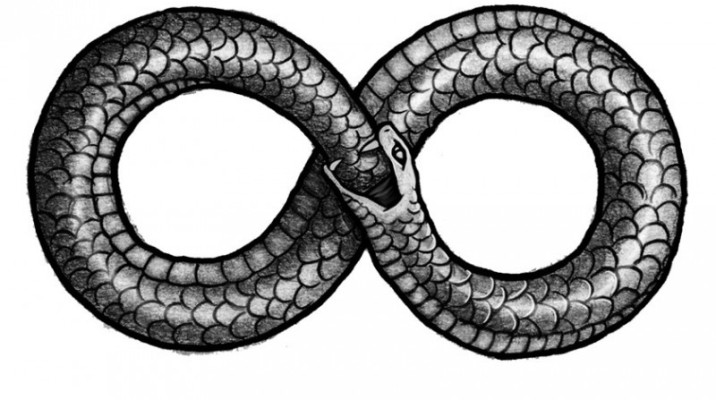
It is therefore no surprise that snakes and serpents feature heavily throughout the book. There is talk of “King Da, the incarnation of the Serpent, which is the eternal beginning, never ending,” as well as the Cobra of the holy city of Whidah, “the mystical representation of the eternal wheel.” Da is short for Damballa, the Vodou God of the Sky, the primary Vodou God. Snakes and serpents feature prominently throughout many religions across the globe. Most (in)famously, the snake in the Garden of Eden seduced Adam and Eve into taking a bite of the apple. This event was the introduction of sin but simultaneously the introduction of time, it was the Kingdom of Heaven tumbling down to earth. Earth, which is another thing the snake symbolises. Stealthily and steadily, it creeps along, always touching base. Most of all, though, the snake is associated with cycles and renewal. It sheds its own skin to be born again, and is often represented as a circle, biting its own tail. The snake is therefore the great adversary of any revolution, a symbol of inevitability, of always ending up back where you began. Indeed it begs a question Carpentier dutifully asks: “Could a civilized person have been expected to concern himself with the savage beliefs of people who worshipped a snake?” Probably not.

Perhaps it is to such a background that we can understand why King Henri-Christophe, that first of Black kings, was more inspired by Napoleon than by endemic rulers and gods. He wanted to make his mark upon place and time, and in the north of Haïti, near Milot, he had his slaves built him a palace and a citadel. The Citadel La Ferriere, which Carpentier calls “a mountain on a mountain”, rose above the palace Sans Souci. Henri-Christophe chose elevation, that easiest of symbolisms, to help him on his way to immortality, to help him stand “on his own shadow”. Now, two hundred years later, as you might guess, all that is left of those palaces are ruins. A UNESCO heritage site. Suitable for photographs only.
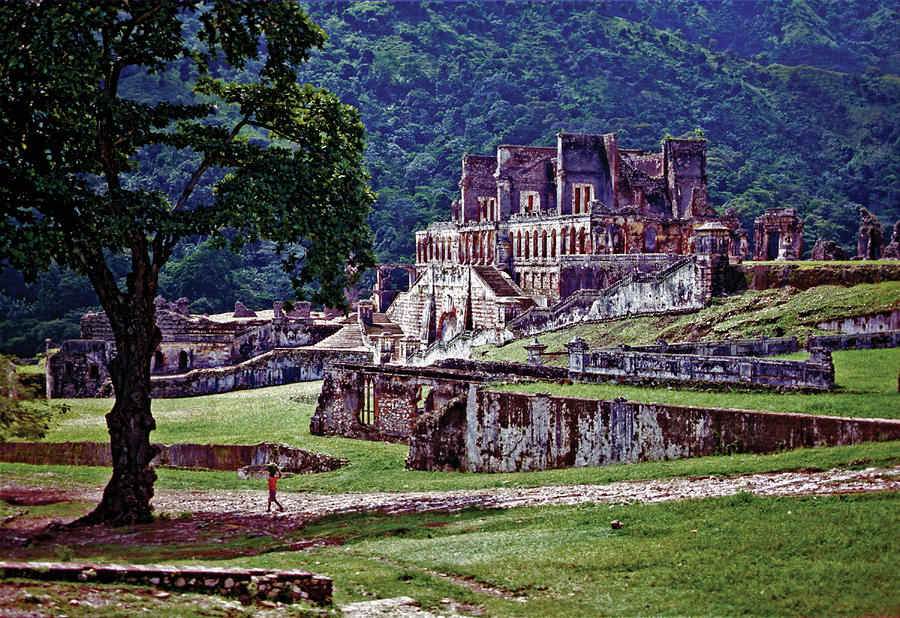
There is something tragic about that. Apart from all manner of other things, the many leaders of the Haitian revolution left a string of capitals behind them: Cap-Haïti, Milot, and Dessalines (then Marchand), before finally deciding on Port-au-Prince. These former capitals seem forever ruined, living not, like Henri-Christophe, on their own shadow, but under a shadow of fame and grandeur that will always eclipse them, the way the palace Sans Souci and the mountain-on-a-mountain citadel still tower above the small town of Milot. These places seem to exist only as a chapter in a history book. It is hard to fathom that people still live and die there.

Finally, the Eagle

Happy are those who read only one chapter of life. Those who depart at the birth of empires bear with them the impression of their perpetuity; those who die at their fall, are buried in the hope of their restoration; but do you not realize what it is to see the same things unceasingly,—the same alternation of prosperity and desolation, desolation and prosperity, eternal obsequies and eternal halleluiahs, dawn upon dawn, sunset upon sunset?

- Machado de Assis, Life (1921)


Alejo Carpentier, born and raised in Cuba, knows all of this better than I do, of course, and he concludes his narrative in absolutely breathtaking fashion. The words to follow can only come from an old man, Ti Noël, who, with “beclouded eyes”, has seen everything and has finally given in to “this endless return of chains, this rebirth of shackles, this proliferation of suffering, which the more resigned began to accept as proof of the uselessness of all revolt.” More than a century later, men like Sartre and Fanon would suggest the opposite, that only revolt is useful, but these words ring far away and faint in the face of Carpentier's story. They ring faintly, too, perhaps, in the headlines of today, in the endless struggles of African countries fighting for freedom. In two incredible paragraphs, Carpentier caught the beauty of this fight as well as its ultimate resignment and futility:

He lived, for the space of a heartbeat, the finest moments of his life; he glimpsed once more the heroes who had revealed to him the power and the fullness of his remote African forebears, making him believe in the possible germinations the future held. He felt countless centuries old. A cosmic weariness, as of a planet weighted with stones, fell upon his shoulders shrunk by so many blows, sweats, revolts. Ti Noël had squandered his birthright, and despite the abject poverty to which he had sunk, he was leaving the same inheritance he had received: a body of flesh to which things had happened.

Now he understood that a man never knows for whom he suffers and hopes. He suffers and hopes and toils for people he will never know, and who, in turn, will suffer and hope and toil for others who will not be happy either, for man always seeks a happiness far beyond that which is meted out to him. But man's greatness consists in the very fact of wanting to be better than he is. In laying duties upon himself. In the Kingdom of Heaven there is no grandeur to be won, inasmuch as there all is an established hierarchy, the unknown is revealed, existence is infinite, there is no possibility of sacrifice, all is rest and joy. For this reason, bowed down by suffering and duties, beautiful in the midst of his misery, capable of loving in the face of afflictions and trials, man finds his greatness, his fullest measure, only in the Kingdom of this World.

Throughout mythology, the conflict between the eagle and the serpent is a constant one. The serpent is bound to earth while the eagle soars in spiritual flight. In light of all this, when after all his toils Ti Noël is last spotted by that “wet vulture who turns every death to its own benefit,” that is exactly the way it should end. Death should not come any other way. Like his country, the slave succumbs to the vacuum.

Ouroboros, Greek for tail-devouring snake, might be the most famous version of the snake that symbolizes the circular. Ozymandias, the Greek moniker for Ramesses II, is the ruler best remembered for not being remembered. Shelley's poem on Ozymandias has become synonymous with the inevitability of time. Like the eagles and vultures gnawing on Ti Noël's bones, Ozymandias signifies that even if you are remembered through time, you have no control over how and why. King Henri-Christophe's grand kingdom might have faded away, but he will be remembered in Carpentier's precise and poetic diction.

If history is truly the cruel mistress it sometimes seems, our protagonist Ti Noël will be born again shortly after resting his weary bones, perhaps on the other side of the island, the other side of the battlefield, and the other side of the revolution. Like the unfolding of Pandora's Box, his memory will have shed everything of that tired past except hope. Hope will stick to him forever, in its short one-syllable, four-letter incarnation, refusing to elaborate upon itself, defined only vaguely as somewhere between the Serpent and the Eagle, incorporating both Ouroboros and Ozymandias.


Saturday, March 22, 2014

Generation W/E

A week ago, in an Anobium article, I referred to the 'whatever' gesture, which for some people, including Thomas de Zengotita, is the ultimate shibboleth of the Culture of the Shrug, of the modern generation. Zengotita pointed out that “haunting the moment of ‘I can experience whatever I want’ is the moment of ‘What difference does it make,’ because this moment, the moment of the shrug, is essential to our mobility among the options.” In an influential article in the New York Review of Books, novelist Zadie Smith dubbed the modern youth as Generation Why, but I think Whatever fits better.

When the “whatever” floated to the online sphere, it had to adapt. No longer could the sigh or the shrug or the blank expression drive the mindboggling apathy home; no, something else had to be devised. “Whatever” as a word, as a response in a chat window, on a forum or a social network, was no longer good enough. It could be too emphatic, the effort of eight keystrokes to conjure up the word did not gel well with the perceived result. The solution: w/e. A perfectly balanced abbreviation, not only shorter but also featuring a nice slash which might well indicating some sort of wavering, an unsteadiness, even an unwillingness, to take position. In that Anobium article I decided not to breach an interesting and important sidenote to the TL;DR, which is of course that it is itself an abbreviation – as with “w/e”, writing down the whole of too long; didn't read would lessen the effect. TL;DR values the effort of the other user with a mere five keystrokes – a denial as strong and as shrugly (yup, I'm gonna go with that) as the w/e.

A few weeks ago I was cycling around my hometown and suddenly thought of the Arctic Monkeys. I realized, with a shock, that 2006 – the year of their breakthrough – was now eight years behind us! Eight years seemed a monstrous gap in my head. It was mostly poignant because I consider their debut record a momentous occasion, a generation-defining thing. Perhaps it did not transcend subcultures like the Beatles, Sex Pistols and Nirvana before them, but it was the best we had. I didn't realize why it served so well to define us back then, probably because I was in the midst of it all. Plus, of course, I was sixteen. Looking at it now from a distance I can see it clearer.

I'm sure it's just a coincidence, but Zadie Smith's article is also from 2006. Slightly less coincidental, Arctic Monkeys are usually credited with being one of the first bands that shot to fame through the internet. They are the Generation Why, but that's not what makes them special. Most of the young bands since then are a part of this generation. No, it is because Alex Turner is both inside and outside of it, because he is extraordinarily tuned to the peculiarities of his mates. He sees the phoniness in Fake Tales of San Francisco, where a band of also-rans plays a gig that only their girlfriends enjoy – from which Turner concludes that “love's not only blind, but deaf,” - he sees our drifting attention in Red Light Indicate Doors Are Secured, whose narrative keeps jumping from the taxi to a review of the night out, but he sees it most of all in the inability or unwillingness to go through with anything at all, an unwillingness to care and get involved. “What do you know?” he asks, then straightways answering “Oh, you know nothing. But I'd still take you home.” Whatever. When they go to a night club in From the Ritz to the Rubble and are held up by some bouncers, they just turn and go home. Whatever. After a while he is just spelling it out: “Thinking about things, but not actually doing the things.” Whatever. Most of the stories of wild nights out on the record are probably only thought of and imagined too. Whatever.

The title says it all, really: Whatever People Say I Am, That's What I'm Not. Personalities as slippery as eels, refusing to be pinned down, changing gears only for reactionary reasons. We don't want to be pinned down because we don't want to seem like we care, and perhaps the Internet's faultless memory also contributes. One strong stance of the past can haunt you forever. Better to just muddle in the middle.

Turner is not a poet, or a “spokesperson for a generation” or any of that baloney. He is simply a person, capturing that which is going on, being honest about it. Because – and this is my favorite part – in the closing song A Certain Romance, after one long cynical rant, the point of which being “that there ain't no romance around here,” he finally admits that all these annoying habits are not quite the same when it concerns friends of you. “They might overstep the line, but you just cannot get angry in the same way.” If only for this observation, Alex Turner has added something of value. Everyone can moan and complain about “modern times,” but we are all a part of it. I cannot think of anyone who is truly exempt. It's just that we happily turn a blind eye when our nears and dears are implicated. And that's just fine. Or maybe not. w/e.

Sunday, March 2, 2014

Ode to the Gentle No

A gentle mix of harpsichord, strings and guitar, and the soaring voice of a young girl. “You and I travel to the beat of a different drum,” she laments. This is how young Linda Ronstadt presented herself to the world, and you could argue she never soared higher than on that first hit single, Different Drum. Rejection songs are interesting, I think, especially when they are as "nice" as this one. Don't get me wrong, I enjoy a good screw-you to a former lover in its time, but that is so much easier, in a way.

The commence of love is a solicitation, a meeting, weighing, of souls. We have enough testimonies on how great it feels when the scales even out, but when something shifts the weight, skews it, it is an altogether sadder story - sadder in sadness perhaps than the greatness is great when it does work out. “This is a gentleman's excuse me, so I'll take one step to the side,” sings Fish (of Marillion fame) in what might just be the most polite break-up song ever. Also in this genre is the accidental rendezvous of former lovers in Stars' Your Ex-Lover Is Dead: here is a love that has been and gone and, as it sometimes happens, both of the involved are fine with it: “I'm not sorry I met you, I'm not sorry it's over, I'm not sorry there's nothing to save.”

That takes care of the present and the future of a relationship. Different Drum takes up the challenge of politely breaking off what never was. “Oh, don't get me wrong,” Ronstadt sings, “it's not that I knock it.” And she later even acknowledges the boy's good looks. Now, this could also be the kind of apologetic stance that makes things worse (of the it's-not-you-it's-me variety) but it doesn't feel that way. It feels sincere. No egos were hurt in the unfolding of this particular tale. It simply wasn't quite the right moment for love. Maybe later. Maybe not.

The truth is of course that break-ups and courtships hardly ever work like this. We all know this, which is why we can appreciate the magic when it does. It might not be quite as glamorous a magic as the magic of love, but to me it is quite wonderful in itself. Sometimes, it is just fine to end up being two ships that pass in the night.

Wednesday, February 19, 2014

What We Talk About When We Talk About Airports

- Robert Montgomery


Sometimes, when I need to head back home from Amsterdam to Leiden at night, I opt for the connection that has me wait over at Schiphol airport (which is en route) instead of at the Amsterdam train station. I get out of the train there and walk around the desolated halls of the airport. The glass edifices, the ubiquitous chain stores - Starbuckses and Burger Kings, - and overpriced souvenir shops, but most of all, the people. When you walk into an airport during the day, there is the bustle of life being made. People are moving swiftly in the fast lane, are taking their life into their hands. It is hard to imagine someone taking an airplane as not for a moment making some headway within their own infinitesimally confined destiny. Departing from an airport is the start of something, even if you are a businessman who does it on the daily. There is an inevitable sense of purpose.

At night, there is none of that. People saunter. I see a man spend at least a minute getting the change together to buy a sandwich. When do you ever see that during office hours? The man queued up behind him does not mind, nor does the clerk. There is no time here, now. There is never any time in airports. Maybe this is because they are always brightly lit; you have to peer past the glass facade to discern the time of day. Of course, there is departure time, but this is a notion seemingly abstracted from the sanitised hallways of the airport. It is just a number hanging in the air that cannot be properly wedded to the place. Is that, perhaps, because airports themselves are not grounded in a place? This is curious, because air travel is so concerned with space, with moving, with going somewhere and arriving somewhere else. But you wouldn't know this judging from the airports. They are void of local flavor, they are naught but places of transaction. You pay to come and go.

“Down by the tracks,” sings (ex!-claims!) mewithoutyou's Aaron Weiss in their song Carousels, “Watching trains go by to remind me there are places that aren't here.” This is the flip side of that paradox, the spacelessness of airports. In its own absence, it embellishes all the places that you normally would not think of as places. The terminal is an interim. It is purgatory.

Nowhere is the appeal of the airport more concentrated than in the television screens that hang in rows from the terminal ceilings to announce the departure and arrival of flights, whose absence of aesthetic self-consciousness and whose workmanlike casing and pedestrian typefaces do nothing to disguise their emotional charge and imaginative allure. Tokyo, Amsterdam, Istanbul; Warsaw, Seattle Rio… The constant calls of the screens, some accompanied by the impatient pulsing of a cursor, suggest with what ease our seemingly entrenched lives might be altered were we simply to walk down a corridor and onto a craft that in a few hours would land us in a place of which we had no memories and where no one know our name. How pleasant to hold in mind through the crevasses of our moods, at three in the afternoon… that there is always a plane taking off for somewhere, for Baudelaire’s ‘anywhere! anywhere!’: Trieste, Zurich, Paris.

- Alain de Botton, On Travel


Perhaps they are even more than purgatory: heaven itself. So brightly lit. The stewardesses as angels, the pilot as God? You put your life in their hands, but statistically speaking - and I think outside of the scare times directly following terrorist events most people do feel this way - air travel is an extremely ritualistic and structured thing. It usually unfolds exactly as planned. Every flight is virtually the same. Ritualistic in a religious way almost. Perhaps we have to get a little religious in order to fend off the idea that we are defying gravity. For Don DeLillo, always looking for what best defines the modern age, airports are safe havens; they are places in which your children can grow up.

Planes and terminals are the safest of places for the very young and very old. They are looked after, smiled upon, admired for their resourcefulness and pluck. People ask friendly questions, offer them blankets and sweets.

"Every child ought to have the opportunity to travel thousands of miles alone, " Tweedy said, "for the sake of her self-esteem and independence of mind, with clothes and toiletries of her own choosing. The sooner we get them in the air, the better. Like swimming or ice skating. You have to start them young. It's one of the things I'm proudest to have accomplished with Bee. I sent her to Boston on Eastern when she was nine. I told Granny Browner not to meet her plane. Getting out of airports is every bit as important as the actual flight. Too many parents ignore this phase of a child's development. Bee is thoroughly bicoastal now. She flew her first jumbo at ten, changed planes at O'Hare, had a near miss in Los Angeles. Two weeks later she took the Concorde to London. Malcolm was waiting with a split of champagne."

Barring mechanical failures, turbulent weather and terrorist acts, Tweedy said, an aircraft traveling at the speed of sound may be the last refuge of gracious living and civilized manners known to man.

- Don DeLillo, White Noise

Aerotropolis

Perhaps airports should be a warning for us. Their calculated, structured, trusted ways might spread across the lands. This is the future as envisioned by John Kasarda, as chronicled in Aerotropolis by Greg Lindsay. He wants the airport to morph into a city, thus an aerotropolis, which he defines as a “self-contained factory town with assembly lines literally ending in the bellies of waiting planes.” Kasarda calls our modern age the Instant Age, characterized by on-demand services and instant gratification of every desire, or as Umberto Eco and later Thomas de Zengotita had it, by “the moreness of everything.” The aerotropolis seems in a sense like a relic, a belated attempt to better recreate the connected online world in the flesh. Many companies have already created such aerotropoli, their warehouses spawning a small airport and a little town of workers. Will Self, in his review of Lindsay's book, noted that “at the core of Kasarda's conception of the aerotropolis lies the notion that space - unlike time - is fungible.” This peculiar quality of the airport to be of undefined space and time, to be interchangeable, is why the airport is the chosen poison of these architects of the new world. To recreate the Internet in the physical world is to want Instant Everything; everything, everywhere, all the time. This denies local flavor, the idea that places have their own unique footprint, their own pros and cons, have something to offer other than transportable products and experiences.

Will Self has made it a sport of his to walk to and fro airports. Like the surrealists and situationists before him, who recognised the subversive power of walking in the Age of the Automobile, Self similarly acknowledges this in the Age of the Aeroplane, where the debit of displacement is even higher. “I find it uncanny to be in a world in which, as I write this very sentence, I will travel thirty or forty miles through the upper atmosphere,” he writes in Psychogeography. Rebecca Solnit, in her history of walking, Wanderlust, once wrote of her suspicion that “the mind works at three miles an hour”. In fairness, if the future pans out as posited in Aerotropolis, this will cease to matter: every place will look and feel the same, so no mind calisthenics will be necessary to keep up. Will Self finds one such vision of the future in Dubai. After he takes a two-day walk from its airport towards the city center - Dubai, as you might imagine, being a city that sits rather well with Kasarda and Lindsay - he dismisses the duo's utopia once and for all:

My response to this Xanadu - powered by jet fuel and misted by the evaporation of desalinated water - was to stop flying altogether: I no longer wished to pick up any airmiles that contributed to such a future. Perhaps if frenetic flyers like Kasarda and Lindsay ever dared attempt a sustained hike through the wastelands of the postmodern ugliness they enthuse about, they might take a different view. After trekking through Dubai you don't have to be a Platonist to conclude that anything that aesthetically revolting must be not simply amoral, but bad.

Will Self, The Frowniest Spot on Earth


The airport, especially at night, is a pleasant void, where the cropped-up emotions and frustrations of your life will drain away with every plane that takes off. But it is only pleasant because these emotions and frustrations are there in the first place. We should not allow the airport to expand amorphously to cover everything. If we do, we will lose more than we've bargained for.

Saturday, February 1, 2014

Hypnagogues

The instance before you fall asleep.

Have you ever considered this? The instance before you fall asleep? Perhaps, you are one of those lucky dullards who sink into oblivion the moment your left ear touches base, or maybe you sleep on your back, supine like Count Dracula in his coffin. But if you are like me, part of the tossers and turners, endlessly kicking the sheets, fluffing your pillow, sweating, getting out to drink water, kicking the sheets some more, you might have considered it. You might know how scary those moments are, how scary the silence is. Because that is the point: for most people, it is the only moment of silence during the whole day. We get up to the bustle of a day starting, schoolkids and commuters outside, people showering and having breakfast inside, the noise of the gears starting up. Then the rest of the day we are always, doing, something. Whether in the office or at home, there is at least radio and television to stop the gaps, should they occur. There is endless inane chatter to nullify the risks of being reminded of something altogether more primitive and closer to yourself. Yes, there still is something closer, there is an unnameable spirit that stirs inside of you of its own account, one not reduced to tears by a cathartic song or choking with laughter at punchlines; it is what throughout the longest part of history we used to call a soul.

That soul is what is troubling us tossers and turners in those silent moments. Even this problem can be alleviated of course: we can just keep the television on, “singing softly as you fall asleep,” or we can put on a record of “natural” sounds: waterfalls, chirping birds and the like. When we were young, there were adults who wanted to read to us, their responsible, reliable drone soundtracking our journey towards happy oblivion into the night. But perhaps instead of being “problem-solvers”, a much-trained skill in our times, we can appreciate the problem for what it is, a warning sign of some sorts. In a recent Intellegence Squared debate, Will Self argued against the motion We've never had it so good and concluded by urging us to “reject the motion and recover your soul.” What he was pointing out was that in the modern society, only that which can be quantified counts. We are used to on-demand, to instant coffee and instant happiness, while the soul needs to be nurtured over time and handled with kid gloves. Most troublingly, the soul does not come with a soul-o-meter, measuring – quantifying – what works and what doesn't. There is no science of the soul, thank God, which is why we as modern men like to ignore the thing. When a second ago I put the term “soul” to google, it gave me first soul music and then the soul as the quote-unquote immortal essence of a person. I don't know what that says about our society, but I doubt it's good.
Many religious as well as pagan societies celebrate the turning of the seasons. Many of these festivals, like the Mexican Day of the Dead, and the Celtic Samhain (which forms the roots of modern-day Halloween) celebrated and revered the dead, and importantly they considered the veil between the natural and supernatural worlds to be especially transparent on these days. Seances and rituals proliferate. Perhaps the moment after the day ends and before sleep has begun, is akin to this. Not that I am claiming anything supernatural, but, just as an analogy, perhaps we can say that the veil that has been spread between us and ourselves is especially thin at those times. We can finally hear our own thoughts, we can finally be honest with ourselves: “what is going on in my life?”

How often do you do this during the day? When I read a book I usually have a record playing in the background. If I don't, I can feel the silence intrude upon me. Reading is not an intrusive enough activity any more to suffice on its own. Similarly, I can listen to music and stare out of the window and still feel like I am doing nothing at all, even though I am listening to music and staring out of a window. But I can't do absolutely nothing. I cannot sit down in a chair in silence, close my eyes, and think. I cannot eat dinner without watching television or conversing with someone. It seems almost as if I cannot not multi-task anymore. It has become the default state.

Sometimes, finally in bed, there is just too much to process. Since this is the only chance your brain gets to be heard, it will damn sure take it.

I don't know if this is a modern ailment, or if it always was this way. I do think it is a modern thing to want too much – perhaps because we are aware of too much, perhaps because the world has expanded too far around us. We cannot allow ourselves the luxury of doing nothing anymore. But what we can do is take the necessary things and slow them down: walk where you wanted to drive or cycle, write a letter instead of an e-mail (instead of a text (instead of a personal message (instead of a tweet))). Better yet, just as a leisure activity, walk without knowing where you are going. Turn left on a whim, turn right on a whim, turn left again; your head might just clear up, you might be inspired in ways you had forgotten you could be inspired. You might just believe in the soul again, which – in case the word soul makes you uncomfortable – also comes down to saying this: you might just believe in unquantifiability, in uncertainty again. In the best-case scenario, you might just get lost.

Friday, January 3, 2014

The True and Lasting Power of a Name

Alek James Hidell, Francis Gary Powers, James Earl Ray, O.H. Lee, William Bobo, John F. Kennedy, Mark David Chapman, Martin Luther King, John Wilkes Boothe, D.F. Drittal.

Lee Harvey Oswald.

There is something in a name, sometimes. There is some ominous ring, some vestige of history clinging to it, being absorbed, the name growing and growing. There are names and there are names and then there are strong names. Flowing, solid, idiosyncratic, rolling right off the tongue names, names with their own hopes and desires, names trying hard to drive home the idea of nominative determinism, names seeking a place in the graveyard of lapidary history.

It occurred to Oswald that everyone called the prisoner by his full name. The Soviet press, local TV, the BBC, the Voice of America, the interrogators, etc. Once you did something notorious, they tagged you with an extra name, a middle name that was ordinarily never used. You were officially marked, a chapter in the imagination of the state. Francis Gary Powers. In just these few days the name had taken on a resonance, a sense of fateful event. It already sounded historic.

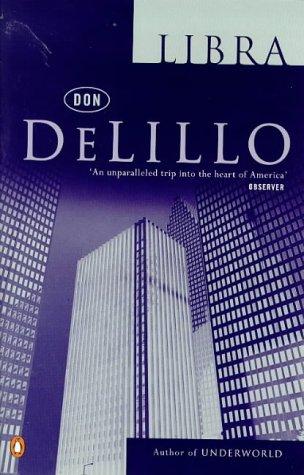
In Libra, his 1988 novel revolving around the double-punch of the JFK assassination and the concurrent shooting of the prime suspect, Lee Harvey Oswald, writer Don DeLillo plays a home game. It is the one thing that has defined his career as a writer, he noted in an interview, the seminal moment in shaping American history right up until that other seminal event; from 11/22 to 9/11, from one double-punch to another.

The obsessive replay of Jack Ruby gunning down LHO, the Zapruder film, the endless tossing and turning and discussing and whirling around, the weighing of facts; these are stock subjects for DeLillo. It was an event, capital E. It was no longer about two men dying and two men brandishing a gun, it was about abbreviations, about JFK and LHO and CE-399, numbers adding up and not adding up, coincidences, patterns.

Men in small rooms

DeLillo follows the many threads of what I would call the side cast, suspect names hovering around the case. One of the characters is the fictional Nicholas Branch, a CIA archivist who, years after the fact, has been burdened with the responsibility of the archive, with making a report out of the totality of data on the case, data which accumulates faster than he can analyze it. Here is another seminal role of the JFK shooting: a foreshadowing of the Information Age. Someone happened to catch the tragic act on tape and the whole nation watched the consequent murder of the suspect live on television. The case is infinite, all the data combinable in endless variations and interpretations. Branch, in a specially built room adjacent to his house, paper stacked up high, could very well be DeLillo himself, overwhelmed by all the possibilities, determined to pull a narrative from the rubble.

Nicholas Branch has unpublished state documents, polygraph reports, Dictabelt recordings from the police radio net on November 22. He has photo enhancements, floor plans, home movies, biographies, bibliographies, letters, rumors, mirages, dreams. This is the room of dreams, the room where it has taken him all these years to learn that his subject is not politics or violent crime but men in small rooms.

There that is: men in small rooms. It could have been spelled in capitals, it could have easily been the name of the novel. This seems to be the essence of all the men (they are all men) who are somehow involved in the assassination plot that DeLillo has cobbled together: Win Everett, T.J. Mackey, David Ferrie, Guy Banister, Lawrence Permanter. Some real, some fictional. Men in small rooms. It calls to mind Dostoevsky in Crime and Punishment, Raskolnikov sweating and steaming in his small garret “like a spider”, caught in his own web, his mind running and running and running, slowly driving himself insane. “Low ceilings and tiny rooms cramp the soul and the mind,” Raskolnikov concludes. Meanwhile, Nicholas Branch sits in his small room analyzing the facts that are not facts and wonders: “Can a photograph be lonely?” Lonely men in small rooms. Lonely important men in small rooms. Their story is, as Adam Curtis says on the subject of spies, "not the story of men and women who have a better and deeper understanding of the world than we do. In fact in many cases it is the story of weirdos who have created a completely mad version of the world that they then impose on the rest of us."

They are men stuck in the past, stuck in grievance and bitterness. Grieved by the failure of the Bay of Pigs invasion, they have a persistent tendency to skip over this unfortunate affair and bask in the glory of their earlier triumphs, Central American invasions of the 30s and 40s, Cuba, Nicaragua, Guatemala. You slip into the feeling that these countries only exist for the benefit of these men, for the benefit of their nostalgia, empty denominators to hang their stubborn egos on.

The internal logic of plots

Any story or narrative of which the ending is set in stone (or perhaps set in blood) gathers an extra dimension, and DeLillo makes good use of this, dithering and backtracking all the time, running around his subject in wider and wider circles while you, the reader, wait for him to get to the gruesome conclusion, get to the fucking point. Similar to watching a movie like Titanic, or The Assassination of Jesse James by the Coward Robert Ford, the ending bleeds into the beginning. For maximum effect, it is best to commence far away, start when Robert Ford is a shy kid, as far removed from a killer as can be, start when Lee Oswald is just a boy raised by a single mum, heckled and bullied, a child like so many others in America. With the end in mind, there is only one direction this kid, still innocent, can go. From the start up, it is set up to be exactly like the incessant instant replays that DeLillo so often remarks upon, the fascination in knowing it will always end the same and the horror found, time and time again, in the confirmation of this law. A car crash unfolding across the slow-motion time span of 450 pages. “All plots move deathward,” DeLillo notes, an idea he had already showcased in White Noise and here returns to.

Plots carry their own logic. There is a tendency of plots to move toward death. He believed that the idea of death is woven into the nature of every plot. A narrative plot no less than a conspiracy of armed men. The tighter the plot of a story, the more likely it will come to death. A plot in fiction, he believed, is the way we localize the force of the death outside the book, play it off, contain it.

Now of course, the subject has been exhausted, the events of November the 22nd, 1963, have been rehashed endlessly by novelists, sociologists, psychologists, philosophers, pedagogues, educationalists, historians, assassination experts, presidential experts, Cuba experts, Soviet Union experts, America experts, Dallas experts, JFK experts, Oswald experts; this is not DeLillo's shtick. He is not a conspiracist. He draws up the blueprint of a conspiracy, the faintest of plots, and then mocks it while it unravels and falls apart. In fact, he is arguing for the exact opposite, that the plot has its own logic, that history cannot be engineered.

If we are on the outside, we assume a conspiracy is the perfect working of a scheme. Silent nameless men with unadorned hearts. A conspiracy is everything that ordinary life is not. It’s the inside game, cold, sure, undistracted, forever closed off to us. We are the flawed ones, the innocents, trying to make some rough sense of the daily jostle. Conspirators have a logic and a daring beyond our reach. All conspiracies are the same taut story of men who find coherence in some criminal act.

But maybe not. Nicholas Branch thinks he knows better. He has learned enough about the days and months preceding November 22, and enough about the twenty-second itself, to reach a determination that the conspiracy against the president was a rambling affair that succeeded in the short term due mainly to chance. Deft men and fools, ambivalence and fixed will and what the weather was like.

This is where the title comes in. Not Men in Small Rooms, like I suggested above, but Libra. The sign. Scales. Weight. David Ferrie tries to convince Oswald of the deathwardness of his own particular plot, that his being a Libra “seems to tell them everything they had to know.” He explains Oswald's behavior, his shifting allegiance between Russian and American causes, between opposite ideologies, as the typical behavior of a Libran, and claims that it is just a matter of tipping the scales either way, of something, somehow, weighing in.

Weighing in. The weight of history. Men in small rooms. Librans. This is what it comes down to. Men like Jack Ruby, haunted and driven by “the shock of what it means to be nothing, to know you are nothing, to be fed the message of your nothingness every day for all your days, down and down the years”. Men wanting to insert themselves into history, men like Lee Harvey Oswald.

He feels he is living at the center of an emptiness. He wants to sense a structure that includes him, a definition clear enough to specify where he belongs. But the system floats right through him, through everything, even the revolution. He is a zero in the system.

Yoni Wolf, singer of the American band Why?, seems to understand. In his Song of the Sad Assassin, he is at a murder scene, but he is simultaneously alone, putting coins into a washing machine. He “feels like the last eight frames of film before a slow motion Lee Harvey Oswald gets shot in the gut and killed.” This is not to say he feels like Oswald. No, he feels stuck in a void, stuck in incessant replay, stuck in a plot that was always turning deathward, stuck in one of the most famous pieces of moving picture ever put to tape, hurtling to a fate even more inevitable than that of all those other figures on other tapes of film; that is, more inevitable than inevitable. He is Lee Oswald realizing the inevitability of turning into Lee Harvey Oswald, a name, a myth.

In the end, Oswald is buried in alienation, loneliness, emptiness, despite everything, under an alias, William Bobo, the last of the many he employed. This happens in Fort Worth, watched over solely by his brother, wife, little girls and mother. The last words in the novel are for this mother, who over the course of the narrative turns into the mother of a myth, not a flesh-and-blood mother, a mother determined to get the story right. Out of love for her son, she claims, but it doesn't really come across as love. It is the same struggle for a sense of structure that occupies everyone else involved. She is ultimately left, not with a son, but merely with a name.

No matter what happened, how hard they schemed against her, this was the one thing they could not take away - the true and lasting power of his name. It belonged to her now, and to history.

Friday, December 20, 2013

I Can See a Better Time

You're a bum, you're a punk
You're an old slut on junk
Lying there almost dead on a drip in that bed
You scumbag, you maggot
You cheap, lousy faggot
Happy christmas your arse
I pray god it's our last.

If you are subjected to a fair dose of radio during the December months, you are bound to build up a solid hatred for nearly every canonical Christmas classic. Smoothened voices sing smoothened words, and you are supposed to believe that the paper-thin veneer of tradition can overcome, just for that small pocket of time, those few days, all your sorrows and troubles.

But even a more honest song, like The Pogues' Fairytale of New York, becomes an endangered animal, on the brink of annoyance, on the brink of kitsch. Admittedly, Shane MacGowan is toying with the idea of kitsch here, time and again. He comes up with lines like "I've got a feeling this year's for me and you," that feel comfortably at home in the Yuletide repertoire (even if, to me, it does not sound like he really means it, he is merely trying to convince himself).

It amuses me to think of families with rosy-eyed, freshly-showered little kids sitting around the hearth, trying to match Shane's shambolic Irish accent and Kirsty's in-your-face performance (perhaps solemnly turning the volume down when the uncouth verse quoted above comes up). It amuses me that every December, when the song is played to death all around the world, Shane MacGowan will be handed the money to sustain his non-stop drinking and smoking habits.

It is a feelgood song, all in all, but Shane does give you a rough and bumpy road towards that Christmas spirit. "I could have been someone," Shane offers, sounding unsure of himself, more a question than a declaration. Kirsty counters: "Well, so could anyone."

Unlike most Christmas songs, this one does not play itself out next to the Christmas tree, shacked up together in warm, unfashionable sweaters, with the aroma of good food around, and happy faces in abundance. It starts out in the drunk tank, with a moping old man, in a desperate bid for a little attention, a little love, stating - like every year, no doubt - that this will probably be his last torturous December. Next thing we know, Shane bets on a horse with long odds and wins what for him must be a small fortune, after which he no doubt turned right around to go on a binge.

They dance and kiss their way through the night. Outside. Perhaps, they too have dreams, tucked somewhere far away, of the Christmas as we always try to picture it, where they are warm and inside and everything is finally okay, but they will never admit it. But either way they have dreams, dreams that, as they start to realize, they need to put together, in order for them to be realized.

All of the above, only really to try to help you understand the beauty of that line at the end, that line that could easily be kitsch when placed in a different song. Here, it is heartwarming, the sincerest of gestures when you most need one:

“I've built my dreams around you.”

Thursday, December 19, 2013

Regarding an Unnamable Non-Manifesto

On the 5th of February, 1909, in a local newspaper in the Italian city of Bologna, the Italian poet Filippo Tommasso Marinetti published a Manifesto that would herald everything that was about to come in the century ahead, both good and bad. It was, of course, the Futurist Manifesto and it started (or just made visible) a storm that is brewing until this day.

Ugo Gianattasio (1888-1958), untitled, 1920

Even if Marinetti's manifesto is, for all intents and purposes, an Art manifesto or, perhaps pluralized, an Arts manifesto — it discusses the best way to produce beauty, after all — it has always had more value as a timeless meditation on how to approach the Great Unknown of the future.

Let us leave good sense behind like a hideous husk and let us hurl ourselves, like fruit spiced with pride, into the immense mouth and breast of the world! Let us feed the unknown, not from despair, but simply to enrich the unfathomable reservoirs of the Absurd!

For Marinetti, the future is the unfathomable reservoir of the absurd, it is a monster, with immense mouth and breast. Years later, Kevin Barnes of the band Of Montreal, would invert Marinetti's words, calling the past “a grotesque animal” in whose eyes you can see “how completely wrong you can be.” But Marinetti and his companions, when they saw the past, saw only something dormant, a sleeping giant turned to stone, a statue memorializing something nobody can even remember. They saw the age of the Novel with capital N, of men with beards encompassing all life in the flimsy pages of their works. They saw Tolstoy and Balzac and Dickens. “Literature has up to now magnified pensive immobility, ecstasy and slumber.” It's easy to see where they were coming from.

And yet it spawns from such a different world than we witness today! It is, like most manifestos (and especially in those days) an attempt to shake things up, to blow life into everything that comes within earshot. It is, in Marinetti's own words, an ode to the beauty of speed. “Beauty exists only in struggle,” he states. It calls to mind André Breton, nearly two decades later, in Nadja, proclaiming that “beauty will be convulsive, or it will not be at all.” Reading this, you'd like to travel back in time, and warn them. Be careful what you wish for: speed will come to you, convulsions will come to you, and then they will immediately pass you by and disappear in the distance. We are now, perhaps, at the other end of the spectrum, where we could do with some dormancy, where we could do with memorials that have no meaning to them. Everything is buried under the dust of words, while the vacuum cleaner of Time, which used to clean up the Ozymandiases of this world, has been constrained. Nothing disappears anymore. Everything is cumulative. Time and Space died long ago and we are “living in the absolute”, “moving at eternal, omnipresent speed.”

Therefore, it is not so odd that John Freeman calls for the beauty of slow, in a Manifesto for Slow Communications. He condemns “the tyranny of e-mail”, where we are all slaves to the non-stop onslaught of communication. However, it does not do to wait for the past to come (back). Perhaps we should take the thesaurus's hint, when it does not even have a good antonym for Futurist. There is simply no such thing as a Manifesto for the Past. But let's at least agree that speed does not look as beautiful when you are inhaling the exhaust fumes of that “roaring motor car which seems to run on machine-gun fire”. Looking at it from behind, I think I would prefer the Victory of Samothrace after all.

Friday, September 27, 2013

All the News That's Fit to Compute

Between the hours of four and six a. m., one after the other, according to their station upon the roll, all the mails from the N[orth] — the E[ast] — the W[est] — the S[outh] — whence, according to some curious etymologists, comes the magical word NEWS — drove up successively to the post-office, and rendered up their heart-shaking budgets ; none earlier than four o'clock, none later than six. I am speaking of days when all things moved slowly.

Thus wrote Thomas De Quincey in his Confessions of an English Opium Eater in 1821. I really love that apocryphal etymology of the word news. I wish it were true.

Old news

“I am speaking of days when all things moved slowly,” he writes, probably quaking in his boots in the advent of the steam age, the advent of train transport and the telegraph and all things T. In our digital age it is hard to comprehend the physical limitations of the past in such simple things as transmitting a message, but there it is. In vast ancient kingdoms, news was always, inherently, old news, a gaze into the past, like the light of distant stars.

But messages can be useful. Communication is important. It is the invention of news for news' sake (for no sake in particular) that has always confounded me. A moral stigma is attached to 'keeping up to speed with the world'. I can see how newspapers are useful in times of religious, governmental or feudal repression. The idea of decentralizing news was perhaps therefore honorable, but the whole idea of independent news seems a utopia. Surely all newspapers have an agenda or at least strong political leanings. These days, for instance, nearly all newspapers include advertising (or even advertisements dressed up as articles).

Back in 1854, in Walden, Thoreau complained about the pointlessness and vacuity of reading the papers:

And I am sure that I have never read any memorable news in a newspaper. If we read of one man robbed, or murdered, or killed by accident, or one house burned, or one vessel wrecked, or one steamboat blown up, or one cow run over on the Western Railroad, or one mad dog killed, or one lot of grasshoppers in the winter, we never need read of another. One is enough. If you are acquainted with the principle, what do you care for a myriad instances and applications? To a philosopher all news, as it is called, is gossip, and they who edit and read it are old women over their tea.

Jorge Luis Borges must have felt the same way about it, and he never tries to hide his contempt of journalists in his stories. He felt that newspapermen wrote for oblivion. During the Second World War, according to Cees Nooteboom in Een avond in Isfahan, instead of reading the newspapers, Borges was reading the Annals of Tacitus on the Punic Wars. “He called the newspaper ‘that museum of everyday trivialities’, he despises that which I love.” Yes, Nooteboom is famous for his travel writing, and everywhere he goes he picks up the newspaper to get the hang of the place. Poet David Berman does the same thing, though at the same time he subscribes to Thoreau's point of view, or has to admit, at least, as Mark Twain so elegantly formulated, that if history does not repeat itself, at least it rhymes:

Sometimes I am buying a newspaper
in a strange city and think
"I am about to learn what it's like to live here."
Oftentimes there is a news item
about the complaints of homeowners
who live beside the airport
and I realize that I read an article
on this subject nearly once a year
and always receive the same image:

I am in bed late at night
in my house near the airport
listening to the jets fly overhead
a strange wife sleeping beside me.
In my mind, the bedroom is an amalgamation
of various cold medicine commercial sets
(there is always a box of tissue on the nightstand).

I know these recurring news articles are clues,
flaws in the design though I haven't figured out
how to string them together yet,
but I've begun to notice that the same people
are dying over and over again,
for instance Minnie Pearl
who died this year
for the fourth time in four years.

New news

A squirrel dying in front of your house may be more relevant to your interests right now than people dying in Africa.

Thus spoke Mark Zuckerberg. Without wanting to judge it, that single sentence by one of the most influential people in the world right now might summarise best of all the way news is going. The problem outlined above about news is that popular news tended to repeat itself, because popular subjects never changed. People are drawn to disasters and gossip. There was just no market for marginalized culture. Now, with the Internet, that changed.

You might not have heard about it, but a few months ago Google silently abandoned its Reader project. Google Reader was the most popular RSS reader service. That it was not popular enough for Google to want to sustain it, is telling for the fate of RSS. The RSS protocol allows for subscription to specific news sources, essentially allowing everyone to compile his own news channel. The reason it is on the way down, I think, is because it misses an important Web 2.0 aspect: interactivity (which is just a front for: information). If everyone uses RSS, news aggregate sites cannot rank news articles, and Facebook cannot count likes, and we cannot show our love. There would be no button for us to click on. Because that is the future. We select the news. You might consider that democratic, and a good thing, but please read that Zuckerberg quote again. According to research, more and more people use Facebook as an access point to news. Facebook is very oblique about its algorithm for sorting updates. Effectively, they decide what kind of news is important to you, and they have peculiar views on it.

Another part of that democratization that we all love, is the ability for everyone to comment. Everyone who has ever perused a comment section of almost any website, knows that just because everybody can be an author does not mean that everyone should be. As Charlie Brooker has it:

These days most newspaper sites are geared towards encouraging interaction with the minuscule fraction of readers who bother to interact back, which is a pity because I'm selfishly uninterested in conducting any kind of meaningful dialogue with humankind in general. I'd say Twitter's better for back-and-forth discussion anyway, if you could be arsed with it. Yelling out the window at passersby is another option.

When it comes to comments, despite not being as funny as I never was in the first place, I get an incredibly easy ride from passing wellwishers compared with any woman who dares write anything on the internet anywhere about anything at all, the ugly bitch, boo, go home bitch go home. Getting slagged off online is par for the course, and absorbing the odd bit of constructive criticism is character-building. The positive comments are more unsettling. Who needs to see typed applause accompanying an article? It's just weird. I don't get it.

The point being, that comment sections, instead of being innocent and independent addendums to a news site, help form the articles itself, because it's very hard not to have their vocal power in mind when writing something on the Web. The volume of the Mob is a strong and intimidating one, and it might keep a lot of interesting people from posting, from sharing news.

Future news

In 2009, when Tiger Woods was in the news for having an affair, the media had a problem: there were no images to be shown, be they still or moving. Luckily, technology offered a solution: we just create a simulation and that will do. Next Media Animation, a Taiwan company, has made a living doing just that: turning news into animation, animation into news. I think this is the logical next step for news. Since control over everything is what we long for, that includes the news, and we will be able to create the news that we desire, featuring the sound and images we desire, in the order we desire, and we can have them written for us. The world is malleable.

The Internet has evolved into a Star System: though there is so much material available, a small part of it takes all the attention, while the rest amount to towncriers screaming into the void. The future of news will be social, Facebook and the Huffington Post declared. We are social creatures, and we like to follow each other. If everyone truly had its unique news feed, we'd have nothing to talk about anymore. Still, it's a missed chance. The exciting thing about the Internet was that we finally had a choice. The whole experiment of the Web proves that we don't want to have that choice; we want to be led by the hand, we want to be told what to watch, what to listen to and what to read. It's just that we want to be told by different people every now and then, so we don't feel repressed, so we can retain the illusion of freedom. I guess it's a good thing then if in the future the news will be automatically created, selected and spread, without any human input. We prefer to be underlings to robots over being underlings to other humans. We prefer to be all watched over by machines of loving grace.

In the meantime, I'll be sticking to my RSS guns. For what it's worth.

Sunday, September 15, 2013

The Library of Babel

‘There's an app for that’

Black Mirror is a British TV series written by Charlie Brooker (see also this older post), and it is concerned with “the way we live now – and the way we might be living in 10 minutes' time if we're clumsy.” In the first episode of the second season, called Be Right Back, a young woman is struck by the death of her boyfriend, and is aided in the process of grieving by an AI emulation of her deceased love. This is made possible by an online service that analyzes all the social networking data a person has accumulated before his death. It is a fascinating parable on the grief process, and on our ever-increasing urge to stifle all the pain through artificial means.

Be Right Back

In his weekly column for The Guardian a week later, Brooker mentions that seconds after the episode aired, he got a message pointing him to an existing company that actually offered said service. It seems that in this case, his offhand remark that “we might be living like this in 10 minutes' time” was more true than he himself could have imagined.

Jaron Lanier, in his new book Who Owns the Future?, tells a similar story. He was a judge on a mock business proposal panel that served as an exercise for graduate students at UC Berkeley. One of the humorous proposals was the following:

Suppose you're darting around San Francisco bars and hot spots on a Saturday night. You land in a bar and there are a bounteous number of seemingly accessible, lovely and unattached young women hanging around looking for attention in this particular place. Well, you whip out your mobile phone and alert the network. ‘Here's where the girls are!’ All those other young men like you will know where to go. The service will make money with advertising, probably from bars and liquor concerns.

Amused, Lanier then goes on to point out that usually, as he calls it, “Silicon Valley comes through like clockwork”. Though by a different method, the service SceneTap offers to do pretty much what the mock proposal suggested.

This happens more and more and therefore Brooker's ten minutes are not such an outlandish prediction. As Adriaan van der Weel writes, in a discussion on the change from books to digital text, and how to properly bridge the gap:

Any future is unforeseeable, but the problem is that the unforeseeable future is no longer experienced as being far ahead – or even in the future at all: it is constantly with us now.”

Or, as Charlie Brooker himself concludes in the above-mentioned column:

With that in mind, my new rule is that if you can picture something on the cusp of plausibility, it'll definitely be real by Christmas.

Everything must be true

David Kellogg Lewis was an American philosopher who has been very influential during the 20th century. His best known thesis, modal realism, is also his most remarkable. It claims that there are an infinity of possible worlds (think parallel universes), and not just hypothetically: each of them is as real as the one we live in. Every logically possible universe exists. Lewis' thesis was foreshadowed by many sci-fi stories. In one of them, Fredric Brown's What Mad Universe (via Martin Gardner), the characters discuss the consequences of such a thought:

There are, then, an infinite number of coexistent universes.

“They include this one and the one you came from. They are equally real, and equally true. But do you conceive what an infinity of universes means, Keith Winton?”

“Well- yes and no.”

“It means that, out of infinity, all conceivable universes exist.

“There is, for instance, a universe in which this exact scene is being repeated except that you-or the equivalent of you-are wearing brown shoes instead of black ones.

“There are an infinite number of permutations of that variation, such as one in which you have a slight scratch on your left forefinger and one in which you have purple horns and-”

“But are they all me?”

Mekky said, “No, none of them is you-any more than the Keith Winton in this universe is you. I should not have used that pronoun. They are separate individual entities. As the Keith Winton here is; in this particular variation, there is a wide physical difference-no resemblance, in fact.”

Keith said thoughtfully, “If there are infinite universes, then all possible combinations must exist. Then, somewhere, everything must be true.”

“And there are an infinite number of universes, of course, in which we don't exist at all-that is, no creatures similar to us exist at all. In which the human race doesn't exist at all. There are an infinite number of universes, for instance, in which flowers are the predominant form of life-or in which no form of life has ever developed or will develop.

“And infinite universes in which the states of existence are such that we would have no words or thoughts to describe them or to imagine them.”

Somewhere, everything must be true. Of course, this is why David Lewis was talking about logically possible universes. Everything cannot be true simultaneously. But if we accept the premise of these possible worlds, we can instead state that everything, somewhere, must be true.

The Library of Alexandria, the biggest library of ancient times, had as its core mission collecting all the world's knowledge. It flourished in an age when there was less written material, less text, around than there is now. Its mission failed. The library burned down. Now, so many years later, Google has picked up the baton, with its mission to “organize the world's information and make it universally accessible and useful”. It pretty much amounts to the same thing. The problem, I think, is in the word useful. There is an exponential growth of available text. The Internet is realizing Lewis' infinite worlds: for every webpage that claims X to be true, chances are there is at least one out there which claims X to be false.

If we were to fuse Lewis' modal realism and Google's total library, we might just end up with the world that Jorge Luis Borges described in his short story The Library of Babel. Borges describes the universe as a library, with galleries extending indefinitely in all directions. He describes the books as such:

This thinker observed that all the books, no matter how diverse they might be, are made up of the same elements: the space, the period, the comma, the twenty-two letters of the alphabet. He also alleged a fact which travelers have confirmed: In the vast Library there are no two identical books. From these two incontrovertible premises he deduced that the Library is total and that its shelves register all the possible combinations of the twenty-odd orthographical symbols (a number which, though extremely vast, is not infinite): Everything: the minutely detailed history of the future, the archangels' autobiographies, the faithful catalogues of the Library, thousands and thousands of false catalogues, the demonstration of the fallacy of those catalogues, the demonstration of the fallacy of the true catalogue, the Gnostic gospel of Basilides, the commentary on that gospel, the commentary on the commentary on that gospel, the true story of your death, the translation of every book in all languages, the interpolations of every book in all books.

This is, I think, where the Internet and Google by extension, are heading. At first — like the reassuring ‘there's an app for that’ — the thought that everything exists somewhere might be strangely soothing:

When it was proclaimed that the Library contained all books, the first impression was one of extravagant happiness. All men felt themselves to be the masters of an intact and secret treasure. There was no personal or world problem whose eloquent solution did not exist in some hexagon. The universe was justified, the universe suddenly usurped the unlimited dimensions of hope.

On second consideration though, the idea that every combination of letters already exists somewhere starts to depress the people in the Library. It stifles all impulses to write something. As Borges notes:

To speak is to fall into tautology. This wordy and useless epistle already exists in one of the thirty volumes of the five shelves of one of the innumerable hexagons -- and its refutation as well. (An n number of possible languages use the same vocabulary; in some of them, the symbol library allows the correct definition a ubiquitous and lasting system of hexagonal galleries, but library is bread or pyramid or anything else, and these seven words which define it have another value. You who read me, are You sure of understanding my language?)

This is how I feel more and more often. When I have an idea for a story or an essay, I have to repress the urge not to Google it. I have to repress that urge because I am positive I will find something at least very similar to it. It might have always been that way, and the thought that every idea has been thought up before must have crossed the minds of people who lived centuries ago, but now with Google's world of universally accessible information, we can actually check. A good example of how this restrains us is shown in the South Park episode Simpsons Already Did It, in which Butters tries to come up with an evil masterplan, but can't think of one that has not already been done by The Simpsons. The other boys then tell him that, exactly because The Simpsons already did everything, worrying about it is pointless.

Too much talk for one planet

Nevertheless, the main problem remains that having all data does not bring you closer to the truth. As mentioned before, not everything can be true. However, there is a tendency in the Web 2.0 communities to anonymize and objectify information. Wikipedia is the most famous example, but Google Translate is another good one. What looks like magic or a really good understanding of languages, is actually just data. Big, big data. When you request a translation, Google looks for similar translations done before by humans in the past, and takes the necessary words out of this past translation. This is why Google Translate often comes up with very free translations: because people can come up with very free translations. Machines, as of yet, can only translate literally. As Jaron Lanier likes to point out: “digital information is really just people in disguise”. Another point that Lanier hammers home consistently in his books is that information underrepresents reality. We need the person behind the information to frame it, make sense of it.

I think if Google wants to succeed in its mission, it needs our help. Perhaps we all have a responsibility. In another column for The Guardian, Charlie Brooker calls for a reduction of word emission:

If a weatherman misreads the national mood and cheerfully sieg-heils on BBC Breakfast at 8.45am, there'll be 86 outraged columns, 95 despairing blogs, half a million wry tweets and a rib-tickling pass-the-parcel Photoshop meme about it circulating by lunchtime. It happens every day. Every day, a billion instantly conjured words on any contemporaneous subject you can think of. Events and noise, events and noise; everything was starting to resemble nothing but events and noise. Firing more words into the middle of all that began to strike me as futile and unnecessary. I started to view myself as yet another factory mindlessly pumping carbon dioxide into a toxic sky.

There are more people walking around on this planet than ever before and at the same time more people than ever can be considered authors. There is just too much word emission.

It will definitely take more than ten minutes, but I think the way we are heading now we will be left with a Library of Babel of anonymous, big data and no cypher to make sense of it. It will be a future as chaotic as Lewis' infinite worlds. Not even Google will be able to help out.

Tuesday, September 10, 2013

I Agree to Everything

Days of their lives

On April 26, 1949, a psychologist named Roger Barker embarked on an extraordinary experiment in the wonderfully named little town of Oskaloosa in Kansas, USA. It was an extraordinary experiment documenting very ordinary things. Barker went to Oskaloosa, a town of just 725 people, and asked parents if he and his fellow psychologists could be allowed to follow their child for one day. One proud set of parents said yes, and the results were summed up two years later in a book called One Boy's Day.

On that faithful April morning, eight clipboarded men working in shifts followed the boy around to jot down his every action, to the most minute details. The book, again, is extraordinary exactly because of its ordinariness. It tries to be nothing but what it is, and offers no interpretation or judgement on the boy's actions. All it is is a transcription of the events of the day. Thus the book starts:

7:00. Mrs. Birch said with pleasant casualness, "Raymond wake up." With a little more urgency in her voice she spoke again: "Son, are you going to school today?"

7:01. Raymond picked up a sock and began tugging and pulling it on his left foot. As his mother watched him she said kiddingly, "Can't you get your peepers open?"… He said plaintively, "Mommie," and continued mumbling in an unintelligible way something about his undershirt.

And so on, and so forth. You can easily see the value of such a document for historians. A common problem of writing history is that only the history that is deemed eventful and momentous is written down, so we often know disappointingly little of the habits of everyday life in past ages. Of course, the question immediately arises: is the behavior of a boy not changed by the sudden appearance of a clipboarded man? Probably, yes. But as our fantastical canon of children's books can attest to, the younger we are, the more adaptable to unlikely changes. Within a short time, the boy does not seem to notice the clipboard man at all anymore.

Barker and his colleagues went on to repeat the experiment with other kids in Oskaloosa, and the psychologists became a part of life there, blending in the background as it were, like the dark raincoated men in espionage movies. I could not help but think of the movie Synecdoche, New York, where when the protagonist, a theater director, is writing himself in his own play, a man comes up at casting who has shadowed him all his life:

I've been following you for twenty years. So I knew about this audition because I follow you. And I've learned everything about you by following you. So hire me. And you'll see who you truly are. Peek-a-boo.

Days of our lives

One Boy's Day was an experiment. Synecdoche, New York is fiction. No one follows us around. People who claim that they are being followed are called paranoid, and paranoia is a disorder. And yet, with the NSA scandal on our hands, and everything we know now about the privacy policies of the large Silicon Valley corporations, the crazy people might slowly turn out to be correct. Of course, we are not followed by shady men, but by digital networks abstractly compiling the streams of information we willingly send out every day. As British band Hard-Fi sang back in 2005: We're the stars of CCTV, making movies out on the street / We're the stars of CCTV, can't you see the camera loves me?

Willingly? Well, sort of. We agreed, after all. As the documentary Terms and Conditions May Apply points out, these long texts of semi-legal wish-wash that we all skip over when we sign up for something, allow these companies to spy on us without having to call it spying. They simply 'collect data' and all they want is for you to agree to them being able to freely use this data.

As it turns out, just this day I had a university class concerning the form of content, on how we recognize a letter even if all the actual content in it is crossed out. In the spacing, the address at top, and signature at bottom, we recognize the letter. A Terms and Conditions text can also be recognized by form. It generally uses a small type, hardly any spacing, and is quite often written entirely in capitals. Ask any typographer what text is hardest to read and his answer probably amounts to just about the same specifics. This is not accidental. They don't want you to read it. Content-wise, too, it is difficultly formulated and unnecessarily long. Even if you do take the effort to read it, you might still not have a clue what you are agreeing to. Most likely, you will give up and agree anyway.

And so the data accumulates and accumulates and accumulates. If you've been on the web for a while, you might have noticed the slow disappearance of open input fields from social networks. A website like Myspace allowed for a lot of free customization, and people would often write a short bio and a list of their favorite movies and music and books. Importantly, this was a list in text format, without markup. It was hard (though not impossible) to aggregate and sell this data. This is why now on Facebook there is a page or at least an 'object' of some sort for everything, so that all the likes can be easily packaged and sold together to whomever it may concern. There is no risk anymore of valuable data being missed thanks to spelling errors. You know, humane errors. Phew.

Who we truly are

How much data are we talking about, then? When Max Schrems, a student from Austria who was concerned about his digital footprint, requested his file from Facebook (a request which, by law, they have to comply to), he got a whooping 1200 pages in the mail. The files, among many other things, "kept records of every person who had ever poked him, all the IP addresses of machines he had used to access the site (as well as which other Facebook users had logged in on that machine), a full history of messages and chats and even his 'last location', which appeared to use a combination of check-ins, data gathered from apps, IP addresses and geo-tagged uploads to work out where he was." Most alarmingly perhaps, was that deleted data turned out not to be deleted data at all. All that happens when you delete something on Facebook is the addition of a 'delete' flag that hides it from you. It is still there for Facebook to look into. This has large implications. If you are like me, and started worrying about Facebook only later when reports on privacy became more frequent, you might have had a lot of information on your profile at first, and then removed it later. According to Schrems, all that information is actually still there.

In the september issue of Harper's Magazine, writer William T. Vollmann unfolds a similar, though far more disturbing, story. In this article, titled Life as a Terrorist, he too requested his file - at the FBI - and got 294 pages back (though 785 pages were still 'in review' and there might actually be more that they are holding back. Reading through his own files, he suddenly found out that he had been repeatedly suspected as a terrorist, primarily in the nineties threat of the Unabomber. Even after the real Unabomber had been apprehended, Vollmann still experienced long waits, holdups and hostile behavior when he tried to re-enter the USA (his home country) after a trip abroad. He surmises, painfully, that…

I learned that to be suspect, it is enough to have been formerly wrongly suspected.

People will keep on telling you that privacy is unnecessary if you have nothing to hide. Or, as former Google CEO Eric Schmidt once said: "If you have something that you don’t want anyone to know, maybe you shouldn’t be doing it in the first place." If this is the prevailing thought nowadays, we've come a long way from the famous words of Justice Louis Brandeis in 1890:

Privacy is the right to be let alone.

Instead of changing privacy policies, we are attuning our ideas about what privacy entails. If we keep going along this path, we will end up like those kids in Oskaloosa. We will stop noticing the clipboarded men.